


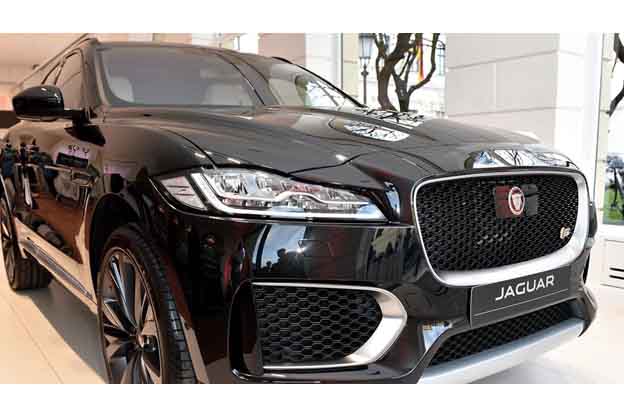
Jaguar
Jaguar is the brand of Jaguar Land Rover. Its CEO is Ralf Speth from February 18, 2010. The founder of Jaguar is William Lyons and William Walmsley. The parent organizations of Jaguar of Tata Motors, British Leyland, British Motors Holdings and Jaguar Land Rover Holdings Limited. The headquarters of Jaguar are in Coventry, United Kingdom. It was founded on September 4, 1922.
Jaguar Cost:
The XF sports a base price of around $50,000.
Most Expensive Jaguar:
- 1966 Jaguar XJ13 – $15,000,000.
- The Jaguar C-X75 concept – $3,000,000.
- 2003 Jaguar XF 10 concept – $3,000,000.
- 2000 Jaguar F-type concept – $3,000,000.
- 1957 jaguar XK-SS – $2,000,000.
- 1994 jaguar XJ220s – $1,800,000.
- 1959 Lister Jaguar Costin Roadster – $1,100,000.
Jaguar Best Car:
- SS Jaguar 100.
- Jaguar F-Type SVR.
- Jaguar XJ-S.
- Jaguar XK120, XK140 and XK150.
- Jaguar XJR-15.
- Jaguar XKSS.
- Jaguar XJ220.
- Jaguar E-Type.
Jaguar Logo:
A large white spotted feline, Jaguar has a traditional symbol of speed, strength, and power.

History:
The Jaguar car is world-famous for its stylish designs, thrilling performance, luxurious and comfortable interiors, outstanding handling and ride, quality engineering, and state-of-the-art technology. No other automobile manufacturer has been as remarkably successful at creating both the world\’s finest luxury sedans, as well as some of the world\’s most beloved sports cars.
The founder of Jaguar Cars Ltd. was Sir William Lyons. His goal was to create world-class sports sedans with \”grace, space, and pace.\” Lyons once said, \”The car is the closest thing we will ever create to something alive.\”

The Jaguar car is produced near Birmingham, England. Its history stretches back nearly eighty years. The company was bought by the Ford Motor Company in 1989. Tata Motors of India purchased Jaguar Cars Ltd. in 2008, and it is rumored it will move the manufacturing plant to India in the future.
William Lyons had founded a company with his best friend, William Walmsley, to make motorcycle sidecars. In 1931, Lyons bought out his partner and began producing his first automobiles. For over thirty years, Bill Lyons personally designed all of the Jaguar cars except the racecars and the E-Type, which were designed by the brilliant Malcolm Sayers.
William Lyons was knighted by Queen Elizabeth in 1956 for his service to the British industry. He was married for 61 years to Greta Brown, and they produced three children. The man known as \”Mr. Jaguar\” died at his home in Warwickshire, and his wife followed him to the grave one year later.
The original name of Jaguar Cars Ltd. was the Swallow Sidecar Company. The first automobile it produced was named the SS 1 (1932-1936), which would go on to sell 4,200 units—a great success for a startup car company in those days. The \”SS\” stood for \”Standard Swallow.\” The Mark VII was next (1951-1956) and 31,000 of these were made. 6,000 of the Mark VIII Jaguar Car (1956-1958) were produced and the Mark IX (1959-1961) reached sales of about 10,000. The XJ 6 sold 82,000 units from 1968 to 1973. In 1972, the new XJ 12 was launched that features the Jaguar V12 engine—the world\’s only mass-produced 12-cylinder four-door automobile. 14,000 XJ 12 models were made. It was the fastest four-door automobile in the world, with a top speed of 140 mph. The XJ (Series II) was produced from 1973 to 1979, with 91,000 sold. These were the first Jaguars ever made that gained a reputation for shoddy workmanship. The problem is easy enough to discern. Labor unions in Britain had grown more and more powerful, and by the 1970s work rules had been forced on manufacturers that left no accountability whatsoever for job performance by employees. The same thing went on in America. That is why the Japanese were able to take huge chunks of the world automobile market—and the market for nearly all manufactured goods—since the 1970s.
The redesigned 1979 XJ6 is thought by many aficionados to be the most beautiful sedan ever created. From that year through 1992, 133,000 XJ6 (Series III) cars were sold, including some 9,000 XJ Coupes (two-doors). The last Jaguar V12 engine rolled off the assembly line in 1997, the same year that saw the end of the XJ6. It was time for something new from Jaguar.
In 2003, the first all-new XJ model since 1986 was unveiled. Its body was of all-aluminum construction, which makes it very light (4,000 lbs.) compared to the competition in its class, even though it is the largest, most spacious Jaguar ever created.
In 2009, the all-new, completely restyled XJ hit the market, a car that is much larger still—both longer and wider.

