


GMC
GMC is an American car and its parent Organization is General Motors. The founder of GMC is William C. Durant and it was founded on 22nd July 1911. GMC serve roles as premium brands designed.
The headquarters of GMC is in Detroit, Michigan, and the United States.
General Motors Canada Limited is the Canadian allied subsidiary of General Motors. The employees are not all Canadian, as some salaried personnel are from the U.S. and work for the company. GM products focus primarily on its four core divisions — Chevrolet, Cadillac, Buick, and GMC.
GMC and Chevrolet:
Although one is produced by Chevrolet and the other by GMC, both trucks fall under the General Motors umbrella. When comparing the Silverado vs. Sierra, it\’s easy to think they are the same. That being said, the two trucks will share many similarities when it comes to the drivetrain and the overall appearance. Moreover, GMC (General Motors Truck Company) and Chevrolet (also known as “Chevy”) are two of the leading brand names of vehicles. The vehicles under this brand, particularly trucks, are mostly identical since they are both manufactured by the same company, GM (General Motors). The Yukon and Yukon XL SUVs are produced at the famous Arlington Assembly plant, of Arlington, Texas. The new GMC Acadia crossover vehicle (CUV) is being produced at the Lansing Delta Township Assembly plant in Delta Township, Michigan. The popular GMC Envoy is built at Moraine Assembly in Moraine, Ohio.
GMC stands for what?
The full abbreviation of GMC is General Motor Company.
Colors For GMC:
- Summit White.
- Sedona Metallic.
- Blue Steel Metallic.
- Quicksilver Metallic.
- Ebony Twilight Metallic.
- Graphite Gray Metallic.
- Satin Steel Metallic.
- Smokey Quartz Metallic.
Cost OF GMC:
The Sierra\’s starting price sits at $29,600, which is about midrange for a full-size pickup truck. There are multiple cabs, engines. The range-topping Denali trim starts at $54,700.
Logo:
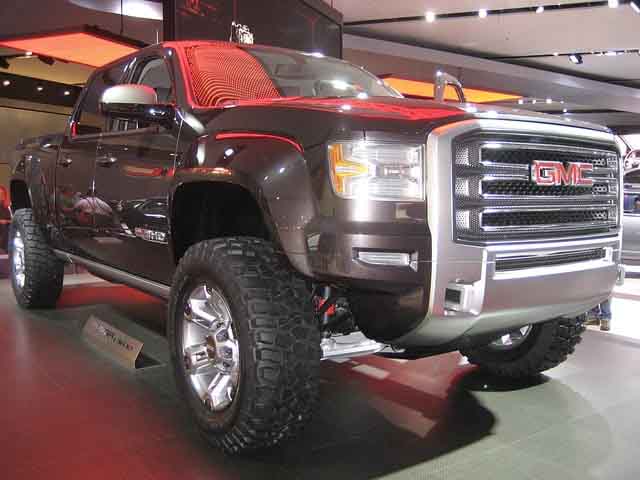
The GMC logo is noticeable in North America. The three alphabets forming the name of the company. The Logo consists only of the letters G, M, C which is painted in red color and is bordered with the silver color.

History:
William C. Durant founded General Motors in 1908
In that first year, 22,000 trucks were manufactured, but GMC only contributed 372 of them.
GMC ran three separate manufacturing locations within the United States. They were located in Oakland, California, Saint Louis, Missouri, and Pontiac, Michigan.
Amid World War II, the company manufactured 600,000 trucks for the United States Armed Forces.
GM purchased most of the Yellow Coach in 1925. They were a bus manufacturer from Chicago and found by John D. Hertz. Once they bought the rest of the shares in 1943, they renamed the company GM Truck and Coach Division.
They produced interurban coaches through 1980, plus transit buses until 1987. Also, they eventually withdrew because the market became too competitive. Then, they sold the company to the Transportation Manufacturing Corporation and Motor Coach Industries of Canada.
In 1927, the company released its T-Series vehicles, and the first GMC truck was born. These early GMC models used Pontiac engines, and these early models from GMC history used Pontiac engines until 1932. The larger, one- or two-ton vehicles used the more efficient and powerful Buick 6-cylinder valve-in-head engines instead.
The company built a new assembly plant in Pontiac, Michigan. At the time, it became the largest plant dedicated to trucks in the world.
By 1931, GMC took control of all the Buick 6-cylinder engine production. In that way, Buick had only been using straight 8s.
In the 1930s, GMC produced 21 truck trailer chassis. They even started making fifth-wheel couplers. In 1936, the company released 15 new products called models. This included panel trucks with Oldsmobile engines and ½-ton pickup trucks. This is also when the Suburban Carryall vehicle first hit production. At the time, it had a two-door design with three available bench seats.
In 1946, they showed their E series. It featured both light and medium-duty trucks. They looked a lot like the company’s earlier models. At the time, they had 48 varieties that offered up to 55,000 pounds GVWR. Then, in 1949, the H Series took over with all recreated chassis and new cabs. Overall, they improved appearance, durability, handling, ride, and driver comfort. This pushed their lineup to 75 models.
Starting in 1957, four-wheel-drive became available on some of the lighter duty truck models. They also pioneered the use of front and rear air suspension. By 1960, most of the GMC models were powered by the GMC V or V12 engine, while the Detroit Diesel 6V-71 was used in the majority of heavier models. By 1968, the company ranked third for United States truck sales, which was a landmark year in GMC truck history.
By 1970, lots of changes were occurring. The new Rally-wagon and Vandura were released. On top of that, Cummins diesel engines became available for most HD conventional cab designs. The company also released the Allison AT540, which was a four-speed automatic transmission featuring a torque converter. They used it in school buses and medium-duty vehicles.
By 1975, the full-size light truck sales began to plummet in response to the worldwide fuel shortage. It didn’t last long though; by 1979, they were again in third for United States truck sales.
In 1981, GM created The General Motors Truck & Bus Group. It included three organizations: Detroit Diesel Allison Division, Bedford Commercial Vehicle of the United Kingdom, and GM Truck & Bus Vehicle Operation. A year later, GMC made its way into the compact truck market with its S-15 pickups.
They also entered into the mid-size van category with their Safari in 1985. They had cargo and passenger varieties for sale, with engine options of a 2.5-liter L4 or 4.3-liter V6. A year later, GM created a joint venture with Volvo to produce and market some heavy-duty trucks.
In 1991, GMC sold more than 3,000 light military trucks. They were either ambulance military or troop carriers.

